Same-Day Sourdough Pumpkin Pull-Apart Cinnamon Loaf
There’s a specific kind of September day up here in Minnesota where you go to bed in summer and wake up in fall. No warning, no gradual transition — overnight there’s a chill in the air and you want something warm and cozy hot from the oven. That’s the exact mood behind this sourdough pumpkin pull-apart cinnamon loaf. It’s what I make on the days I wasn’t planning on fall showing up yet, but the weather had other ideas.
This isn’t a recipe that asks you to plan two days ahead. I use sourdough discard here instead of an actively fed starter, and I give it a boost with a little instant yeast — which does two things for us. First, it speeds the rise up considerably, so this can go from mixing bowl to cooling rack in an afternoon instead of overnight. Second, it keeps the flavor mild and sweet instead of tangy, which matters a lot in a pumpkin-and-cinnamon bread.
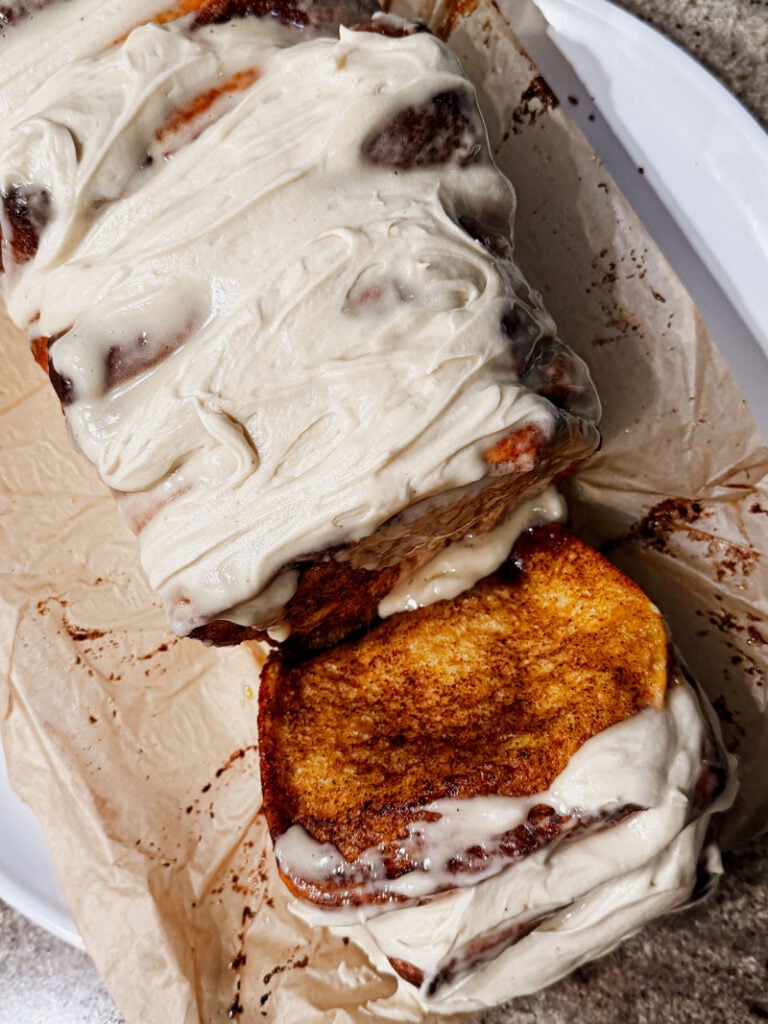
What Is This Recipe?
Think of this as pumpkin cinnamon rolls that decided to change outfits. Instead of rolling the filled dough into a log and slicing individual rolls, you cut the filled dough into squares and stack them on their sides in a loaf pan — like a deck of cards tipped over. As it bakes, the layers puff and fuse just enough to hold together, but stay loose enough that you can pull the loaf apart piece by piece at the table.
What sets this version apart from most pumpkin pull-apart recipes floating around right now is the dough itself. It’s enriched — butter worked in slowly, mixed in a stand mixer — which gives you a soft, tender crumb closer to a brioche than a lean sourdough loaf. And because we’re using discard plus a small amount of instant yeast rather than relying on wild fermentation alone, you get a genuinely same-day bread with a mild, sweet flavor instead of the tang you’d expect from a fully wild-leavened dough.
Why You’ll Love It
- Same-day, start to finish. No starter feeding schedule to plan around — this comes together in an afternoon.
- Not sour. The instant yeast does a lot of the lifting here, which keeps the discard flavor from taking over a bread that’s supposed to taste like fall, not tang.
- A genuinely soft, enriched crumb. This dough is built the way a proper brioche dough is built — slowly, with butter worked in over time — and it shows in the texture. Plus the gorgeous light orange hue from the pumpkin.
- Fun to eat. Pull-apart bread is built for a table full of people reaching in with their hands.
- Flexible for your schedule. Bake it same-day, or mix the dough the night before and cold ferment it in the fridge until morning.
- Doubles as cinnamon rolls. Same dough, same filling — shape it into 6 rolls instead of a pull-apart loaf if that’s what your day calls for.
- A great way to use up discard. If you’ve got a jar of discard sitting in your fridge with nowhere to go, this is where it goes. You can definitely use active starter here instead of the discard.
Ingredient Breakdown
Dough
- Bread flour — 350g (about 2¾ cups): Bread flour gives this enriched dough enough structure to hold its shape once it’s layered with butter and filling, without going tough.
- Pumpkin purée — 150g (about ⅔ cup): Use plain pumpkin purée, not pumpkin pie filling — pie filling is pre-sweetened and spiced and will throw off the balance of this recipe.
- Milk — 100g (about ⅓ cup + 1 Tbsp): Adds moisture and helps activate the yeast. Whole milk gives the richest result, but 2% works fine. You can use any milk of choice. Cold from the fridge.
- 1 large egg: Adds richness and helps the crumb hold together while staying tender.
- Sugar — 75g (about 6 Tbsp): Just enough to sweeten the dough itself — most of the sweetness in this bread comes from the filling and icing.
- Sourdough discard — 100g (about 1/2 cup): Unfed discard straight from the fridge is exactly what you want here. It doesn’t need to be active or bubbly — the instant yeast is doing the rising work, so the discard is contributing flavor and moisture, not lift.
- Instant yeast — 1 tsp: This is what turns this into a same-day recipe. It speeds the rise up dramatically compared to relying on the discard alone, and it also keeps the finished bread from tasting sour.
- Salt — 7g (about 1¼ tsp): Balances the sweetness in the dough and filling.
- Butter — 42g (3 Tbsp), soft: Worked into the dough gradually in the stand mixer for a tender, enriched crumb.
Cinnamon Filling
- Brown sugar — 200g (about 1 cup, packed): The base of the filling — brown sugar gives you that deep, almost caramel sweetness cinnamon rolls are known for.
- Cinnamon — 1 Tbsp: Don’t be shy with it. This is the flavor doing most of the work in every bite.
- Unsalted butter — 85g (6 Tbsp), softened: Binds the filling into a spreadable paste.
Cream Cheese Icing
- Powdered sugar — 1 cup (about 120g)
- Butter — ¼ cup (57g), softened
- Cream cheese — 4 oz (113g), softened
- Vanilla extract — ½ tsp
- Milk or Heavy cream — ¼ cup (about 60g): Used to loosen the icing to a soft, pourable consistency rather than a thick spread.
Step-by-Step Directions
1. Mix the Wet Ingredients
In the bowl of your stand mixer, whisk together 100g (1/3 cup + 1 Tbsp) milk, 75g (6 Tbsp) sugar, 150g (2/3 cup) pumpkin purée, 1 egg, 100g (1/2 cup) sourdough discard, and 1 tsp instant yeast until smooth.
💡 Pro Tip: If you’re mixing with the machine, keep everything except the butter cold, straight from the fridge. Stand mixers generate a surprising amount of friction heat while kneading, and starting cold helps keep the dough from overheating before the butter is even incorporated.
2. Bring the Dough Together
Add 350g (2 3/4 cups) bread flour and mix just until a shaggy mass forms with no dry streaks left in the bowl. Cover and let it rest for 30 minutes — this gives the flour time to fully hydrate before you start kneading, which means less mixing time overall.
3. Knead and Add Salt
Attach your dough hook or spiral attachment (depending on your mixer), add 7g (1 1/4 tsp) salt and mix on low-medium speed for 3-5 minutes, until the dough pulls together into a firm ball.
4. Work in the Butter
Turn the mixer up to medium-high and add 42g (3 Tbsp) soft butter in three separate additions, letting each one fully incorporate before adding the next. This takes about 10 minutes total. You’ll know you’re done when the dough clears the sides of the bowl and the butter has completely disappeared into it.
Note: If the dough looks greasy or won’t stop sticking to the bottom of the bowl no matter how long you mix, it’s usually a sign the dough got too warm during kneading. Pop the bowl with the dough in the fridge for 30 minutes to firm back up, then continue.
5. Bulk Ferment
Cover the bowl and let the dough bulk rise by 50% at room temperature performing two rounds of stretch and folds spaced 30 minutes apart early in that window.
Rather than watching the clock, watch the dough — you’re looking for about a 50% increase in volume. Transferring the dough to a glass measuring bowl at the start makes this much easier to track, since you can mark the level and watch it rise against a clear line. Keep in mind that even with the instant yeast doing most of the heavy lifting, a warmer kitchen will get you there faster than a cool one.
6. Make the Filling
When the dough has risen by about 50%, grab a small bowl and stir 200g (1 cup) brown sugar, 1 Tbsp cinnamon, and 85g (6 Tbsp) softened butter together until you have a smooth, spreadable paste.
7. Roll, Fill, and Cut
Turn the risen dough out onto a lightly floured counter and roll or press it into a neat 9×17-inch rectangle. Spread the cinnamon filling evenly over the entire surface, all the way to the edges. Using a pizza cutter, slice the dough into roughly 3×3-inch squares.
8. Stack and Pan
Line a 9×5 loaf pan with parchment paper — this isn’t optional. The filling has enough butter in it that some will render out as it bakes, and parchment keeps that from turning into a sticky mess stuck to your pan.
Stack the squares on top of each other like a deck of cards, then tip the whole stack onto its side into the pan. Press down gently to settle everything and fill out the pan evenly.
9. Final Proof
Cover the pan loosely and let it proof in a warm spot until it’s fully doubled in size. This second rise moves faster than bulk fermentation since the dough is already warm and active — keep an eye on it rather than setting a fixed timer.
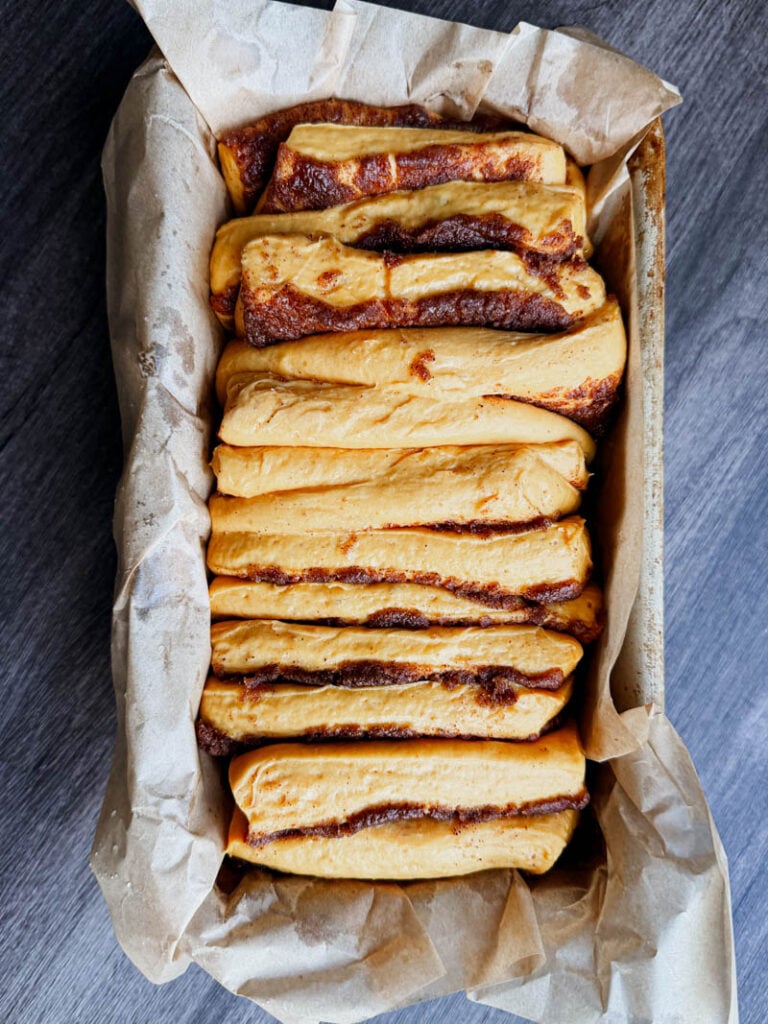
10. Bake
Preheat your oven to 375°F (190°C). Right before it goes in, warm up 1/4 cup of heavy cream in the microwave for 10-15 seconds (just so it’s lukewarm and not refrigerator cold) and pour over the top of the loaf — this will completely transform the texture and flavor. You’ll get ultra soft, pillowy layers.
Bake on the middle rack for about 40 minutes, until the top is a rich, even golden brown. Check at the 25-minute mark, and if it’s browning faster than the inside is cooking, loosely tent it with foil for the remainder of the bake.
Let the loaf cool on a wire rack before icing it. I know that’s hard to do with something this good smelling up your kitchen, but a warm loaf will melt the icing straight off.
11. Make the Icing and Finish
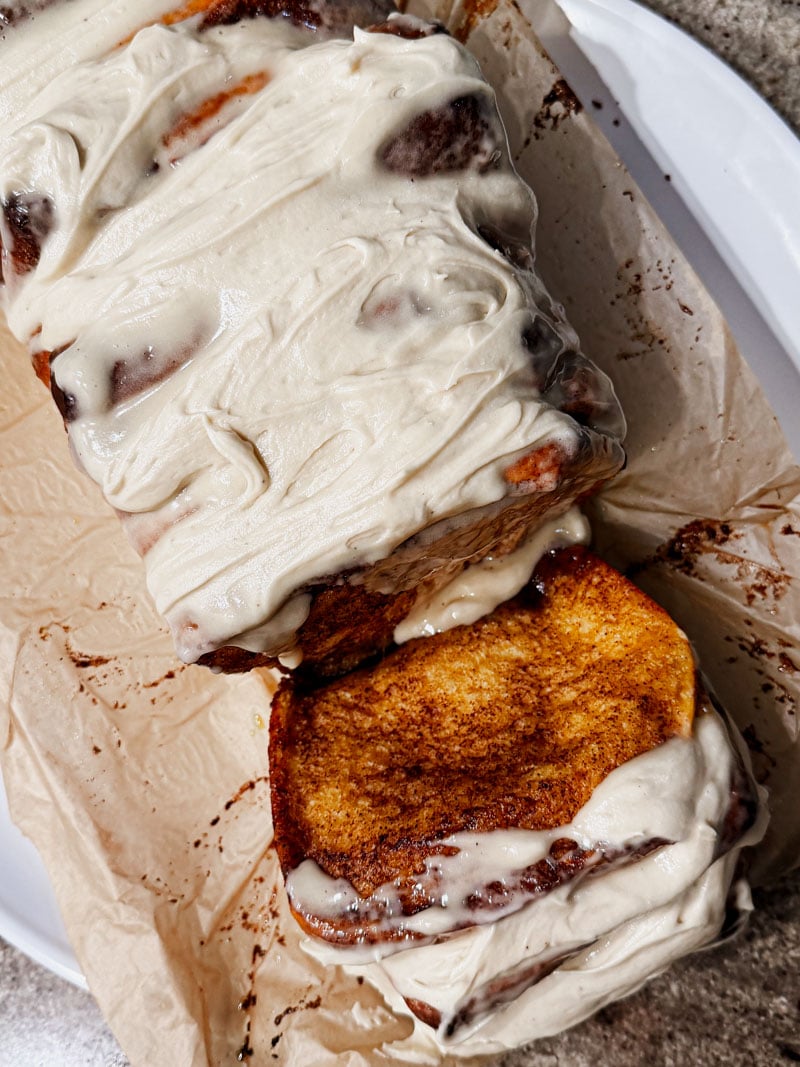
Using a handheld mixer or a whisk, beat 57g (1/4 cup) softened butter, 113g (4oz) cream cheese, and 1/2 tsp vanilla together until smooth. Add (120g) 1 cup powdered sugar and beat until fluffy, then whisk in up to 60g (1/4 cup) milk or heavy cream just to loosen it to a soft, pourable consistency. Drizzle generously over the cooled loaf.
💡 Pro Tip: Pull your butter and cream cheese out for the icing at the same time you start working with the dough. By the time the loaf comes out of the oven and cools, they’ll be perfectly soft and ready to whip — no waiting around at the end.
Variations worth knowing:
- This same dough and filling makes about 6 cinnamon rolls if you’d rather shape it that way instead of a pull-apart loaf.
- To prep ahead, mix the dough the evening before and let it cold ferment in the fridge overnight instead of bulk fermenting at room temperature. The next morning, roll it out, fill, cut, pan, and give it a couple of hours to warm up and rise in a warm spot before baking.
Tools You’ll Want on Hand
- Stand mixer with a dough hook: This enriched dough comes together with far less mess in a stand mixer, though it can be kneaded by hand with a longer time commitment.
- 9×5 loaf pan
- Loaf pan liners: These liners make it a breeze to slip into a loaf pan.
- Glass measuring bowl: Marking the dough level here makes tracking your bulk ferment rise far more reliable than guessing.
- Kitchen scale: The only way to get precise and consistent ingredient measuring results.
- Non-stick rolling pin: My fave rolling pin when using on stickier dough.
How to Store & Freeze
Room temperature: Because of the cream cheese icing, this loaf is best kept at room temperature, loosely covered, for no more than 1–2 days.
Refrigerator: After that first day or two, move it to the fridge, well covered, where it will keep for up to 5 days. Let slices sit out for a few minutes before eating, or give them a quick 20–30 second zap in the microwave to soften back up.
Freezer: For the best texture, freeze the loaf unfrosted. Wrap it tightly once fully cooled and freeze for up to 3 months, then thaw and ice it fresh. If you’ve already iced it, you can still freeze it — just expect the icing texture to soften slightly once thawed.
Troubleshooting
Problem: My dough never fully cleared the sides of the bowl while mixing in the butter. Why it happened: The dough likely got too warm during kneading, which keeps butter from incorporating cleanly. How to fix it: Chill the dough in the fridge for 30 minutes mid-mix, then continue. Starting with cold milk, egg, and discard next time will help prevent this from the start.
Problem: The filling leaked out and pooled in the bottom of the pan while baking. Why it happened: This usually means the squares were stacked a little loosely, or the dough was slightly underproofed going into the oven, giving the butter more room to run before the structure set. How to fix it: Press the stacked squares down firmly when you settle them into the pan, and make sure the loaf has genuinely doubled before it goes into the oven.
Problem: The loaf was dense and doughy in the middle instead of soft and pull-apart tender. Why it happened: Almost always an underbaked center — this is a dense, filling-packed loaf, and color on top can fool you into thinking it’s done before the inside catches up. How to fix it: Use a probe thermometer and don’t pull the loaf until the center reads 198–205°F, tenting with foil if the top is browning faster than the inside is cooking.
Problem: My icing turned out too thin and slid right off the loaf. Why it happened: Either the butter and cream cheese were too soft when you started, or too much heavy cream went in at once. How to fix it: Place in the fridge for couple of hours, then whisk and drizzle.
Problem: The top browned too fast and the center still wasn’t done. Why it happened: Ovens run hotter than their dial suggests more often than you’d think, especially with a loaf this enriched and sugar-heavy. How to fix it: Tent the loaf loosely with foil the moment the top looks close to done, even if that’s earlier than the 25-minute mark, and keep baking until the internal temperature hits target.
Frequently Asked Questions
Can I use pumpkin pie filling instead of pumpkin purée? No — pumpkin pie filling is already sweetened and spiced, and it will throw off both the flavor balance and the texture of the dough. Stick with plain pumpkin purée.
Does this taste sour like regular sourdough bread? No. The instant yeast speeds up the rise enough that the discard doesn’t have time to develop much tang, so this bakes up sweet rather than sour.
Can I use active sourdough starter instead of discard? Yes, you can substitute active starter one-to-one for the discard. If you go this route, use it once it’s domed on top with gentle dimpling across the surface — that’s your sign it’s at peak and ready to fold into the dough, I would still recommend adding at least 1/2 tsp instant yeast for same day bake and to cut the tang.
Can I make this into cinnamon rolls instead of a pull-apart loaf? Yes — the same dough and filling makes about 6 cinnamon rolls if you’d rather shape and bake it that way.
Can I prep the dough the night before? Yes. Mix the dough in the evening and let it cold ferment in the fridge overnight instead of bulk fermenting on the counter. The next morning, roll it out, fill, cut, pan, and give it a couple of hours in a warm spot before baking.
Do I need a stand mixer to make this dough? No, but it makes the process significantly easier and less messy for an enriched, butter-heavy dough like this one. You can knead it by hand — it will just take considerably longer to fully develop.
Ingredients
Method
- In the bowl of your stand mixer, whisk together 100g (1/3 cup + 1 Tbsp) milk, 75g (6 Tbsp) sugar, 150g (2/3 cup) pumpkin purée, 1 egg, 100g (1/2 cup) sourdough discard, and 1 tsp instant yeast until smooth.
- Add 350g (2 3/4 cups) bread flour and mix just until a shaggy mass forms with no dry streaks left in the bowl. Cover and let it rest for 30 minutes.
- Attach your dough hook or spiral attachment (depending on your mixer), add 7g (1 1/4 tsp) salt and mix on low-medium speed for 3-5 minutes.
- Turn the mixer up to medium-high and add 42g (3 Tbsp) soft butter in three separate additions, letting each one fully incorporate before adding the next. This takes about 10 minutes total. You’ll know you’re done when the dough clears the sides of the bowl and the butter has completely disappeared into it.
- Cover the bowl and let the dough bulk rise by 50% at room temperature performing two rounds of stretch and folds spaced 30 minutes apart early in that window.
- When the dough has risen by about 50%, grab a small bowl and stir 200g (1 cup) brown sugar, 1 Tbsp cinnamon, and 85g (6 Tbsp) softened butter together until you have a smooth, spreadable paste.
- Turn the risen dough out onto a lightly floured counter and roll or press it into a neat 9×17-inch rectangle. Spread the cinnamon filling evenly over the entire surface, all the way to the edges. Using a pizza cutter, slice the dough into roughly 3×3-inch squares.
- Line a 9×5 loaf pan with parchment paper — this isn’t optional. Stack the squares on top of each other like a deck of cards, then tip the whole stack onto its side into the pan. Press down gently to settle everything and fill out the pan evenly.
- Cover the pan loosely and let it proof in a warm spot until it’s fully doubled in size. This second rise moves faster than bulk fermentation since the dough is already warm and active — keep an eye on it rather than setting a fixed timer.
- Preheat your oven to 375°F (190°C). Right before it goes in, warm up 1/4 cup of heavy cream in the microwave for 10-15 seconds (just so it’s lukewarm and not refrigerator cold) and pour over the top of the loaf — this will completely transform the texture and flavor. Bake on the middle rack for about 40 minutes, until the top is a rich, even golden brown. Check at the 25-minute mark, and if it’s browning faster than the inside is cooking, loosely tent it with foil for the remainder of the bake.Let the loaf cool on a wire rack before icing it.
- Using a handheld mixer or a whisk, beat 57g (1/4 cup) softened butter, 113g (4oz) cream cheese, and 1/2 tsp vanilla together until smooth. Add (120g) 1 cup powdered sugar and beat until fluffy, then whisk in up to 60g (1/4 cup) milk or heavy cream just to loosen it to a soft, pourable consistency. Drizzle generously over the cooled loaf.
