Ingredients
Method
Step 1: Build the Sweet Stiff Starter (Night Before)
- In a small bowl, whisk 30g (2 Tbsp) active starter into 50g (3½ Tbsp) lukewarm water until it's mostly dissolved. Whisk in 15g (1 Tbsp) sugar, then add 90g (¾ cup) flour. It will be too stiff to stir, so get in there with your hands and knead it into a smooth little ball of dough, about a minute or two.
- Transfer it to a tall jar or container with plenty of headroom. This little ball needs room to triple or even quadruple overnight. Cover and leave it somewhere warm, ideally 75–78°F (24–26°C).
Step 2: Mix the Donut Dough (Next Morning)
- In the bowl of a stand mixer fitted with the dough hook, add all of the sweet stiff starter (about 185g), 100g (⅓ cup + 1½ Tbsp) milk, 150g (⅔ cup, scant) pumpkin purée, 1 egg (about 50g), 70g (⅓ cup) sugar, 8g (2 tsp) vanilla, 1g (¼ tsp) instant yeast if using, and 350g (about 2¾ cups) flour.
- Tear the stiff starter into a few pieces as you add it. It'll disperse into the dough much faster. Mix on low until everything comes together into a shaggy, sticky dough, then bump the speed up one notch and mix for one minute.
- Turn off the mixer and let the dough rest for 15 minutes. This short rest gives the flour time to fully hydrate, which makes the next stage of kneading quicker and smoother.
Step 3: Add the Salt and Butter
- Add 3g (½ tsp) salt and mix on medium speed (speed 3 on a KitchenAid) for about 3 minutes. The dough will start looking smoother and pulling into a rough ball.
- Now add the 43g (3 Tbsp) softened butter one tablespoon at a time, letting each piece fully disappear before adding the next. The dough will look like it's falling apart when butter goes in. It gets slick, separates, and slaps around the bowl. That's normal. Keep mixing and it'll pull itself back together.
- Once all the butter is in, keep mixing until the dough is smooth, glossy, elastic, and clearing the sides of the bowl. Total mixing time is usually 10–15 minutes. Gently stretch a small piece between your fingers. It should stretch thin enough to let light through before it tears.
Step 4: Bulk Ferment — Watch the Rise, Not the Clock
- Scrape the dough into a straight-sided container or a large glass measuring bowl, smooth the top, and mark the starting level with a piece of tape or a dry-erase marker. Cover and let it rise somewhere warm to double its size.
- Want donuts tomorrow morning instead? Let the dough rest at room temperature for 2–3 hours to get fermentation going instead of allowing it to double in size, then cover and refrigerate it overnight.
Step 5: Divide and Pre-Shape
- Turn the dough out onto a well-floured counter. Weigh the whole batch and divide it into equal portions of about 75g each. You'll get 12 donuts.
- Cut 12–14 parchment paper squares, about 3 x 3 inches (8 x 8 cm). Lay them out across two baking sheets and give them a light spray of oil.
- Shape each portion into a tight ball by pinching it together from both sides into the center. Let the balls rest on the counter for 30 minutes so the gluten relaxes.
Step 6: Shape and Final Proof
- Roll each ball by cupping your hand over it and moving it in small circles against the counter. You’ll feel the surface tighten up. Place each one on its own parchment square, spacing them well apart, and cover loosely with plastic wrap.
- Let the donuts proof until roughly doubled in size, puffy, and visibly airy. If your dough came straight from the fridge, this will take a good while longer.
Step 7: Make the Pumpkin Cream Cheese Filling and Spice Sugar
- While the donuts proof, make the filling. In a medium bowl, beat 226g (8 oz / 1 block) softened cream cheese with a hand mixer until smooth and creamy. Add 60g (¼ cup) pumpkin purée, 4g (1 tsp) vanilla, 1g (½ tsp) pumpkin pie spice, a pinch of salt, and 80g (⅔ cup) powdered sugar. Beat until completely smooth.
- Pour in up to 60g (¼ cup) heavy cream and beat for another 1–2 minutes, until the filling looks fluffy and lightened, like a soft cheesecake mousse. Cover and refrigerate it until you're ready to fill.
- For the spice sugar, whisk 100g (½ cup) sugar with 8g (1 Tbsp) pumpkin pie spice in a wide, shallow bowl until it's evenly speckled. Set it next to your frying station.
Step 8: Fry the Donuts
- When the donuts are nearly proofed, pour 1.5–2 L (6–8 cups) oil into your heavy pot, enough for 2–3 inches of depth, and clip on your thermometer. Heat to 350°F (180°C). Line a baking sheet with a double layer of paper towels and set a cooling rack nearby.
- Pick up a donut by its parchment square and gently lower it, paper and all, into the oil. Within a few seconds the paper will release; pluck it out with tongs. Fry 3–4 donuts at a time. Crowding the pot drops the oil temperature fast.
- Fry for 2–3 minutes until the underside is a deep golden brown, then carefully flip and fry the other side for another 2–3 minutes. You'll see that classic pale ring around the middle, the sign of a well-proofed donut. Lift them out with a slotted spoon or spider and drain on the paper towels.
Step 9: Toss in Pumpkin Spice Sugar
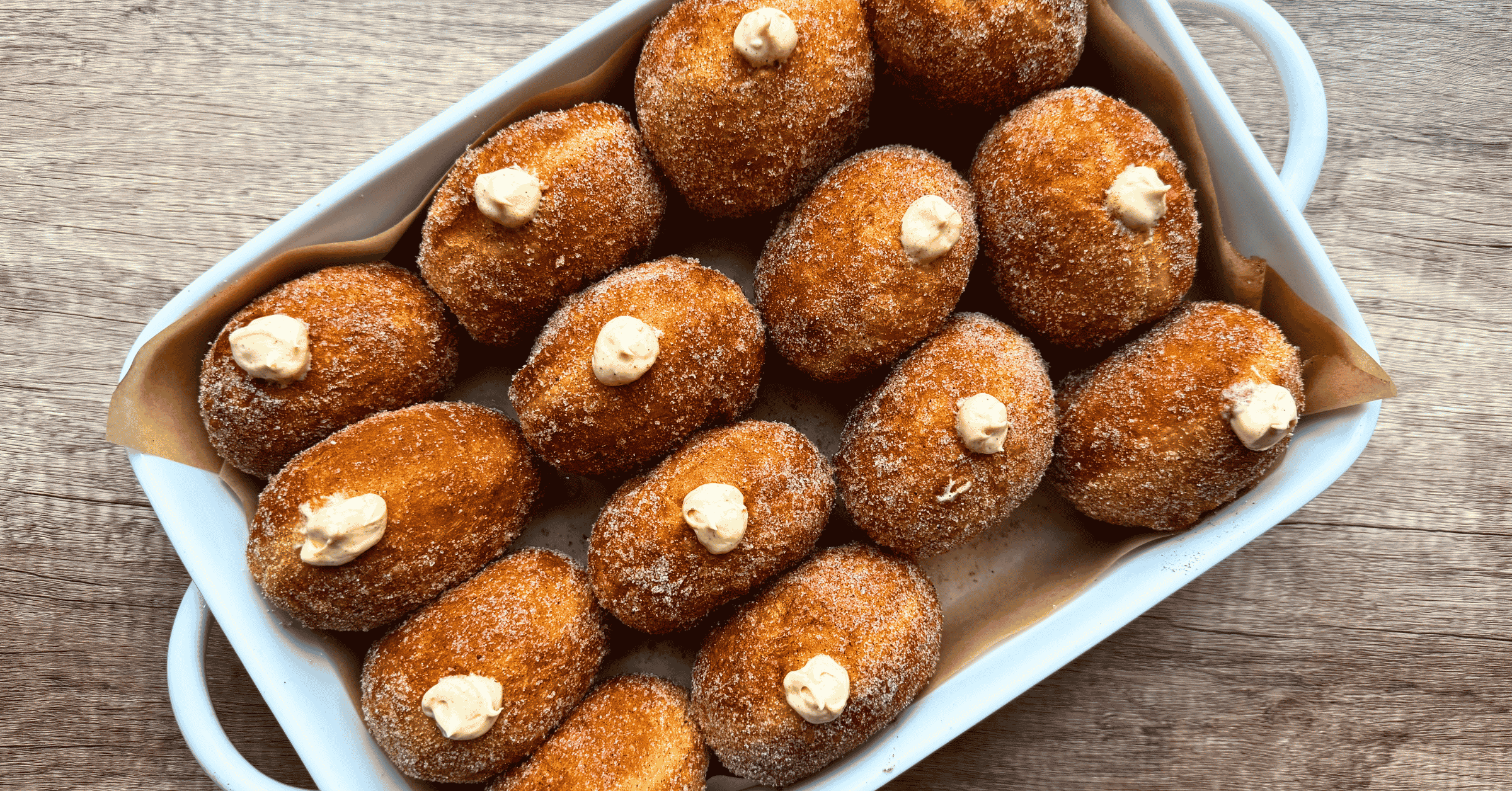
- While the donuts are still very warm, but cool enough to handle, roll each one in the pumpkin spice sugar to coat it completely. The faint film of oil on a warm donut is what makes the sugar cling. Set them on the cooling rack and let them cool completely, about 30 minutes. Meanwhile, spoon the chilled filling into a piping bag fitted with a long filling tip.
Step 10: Fill and Serve
- Poke a hole into the side of each donut with a chopstick or the tip of a butter knife, wiggling it gently to open up a pocket in the center. Insert the piping tip and squeeze until you feel the donut grow heavy in your hand and a little filling peeks back out of the hole.
- Serve right away. Filled donuts are at their absolute best the day they're made, when the sugar is crisp and the crumb is still pillowy soft.