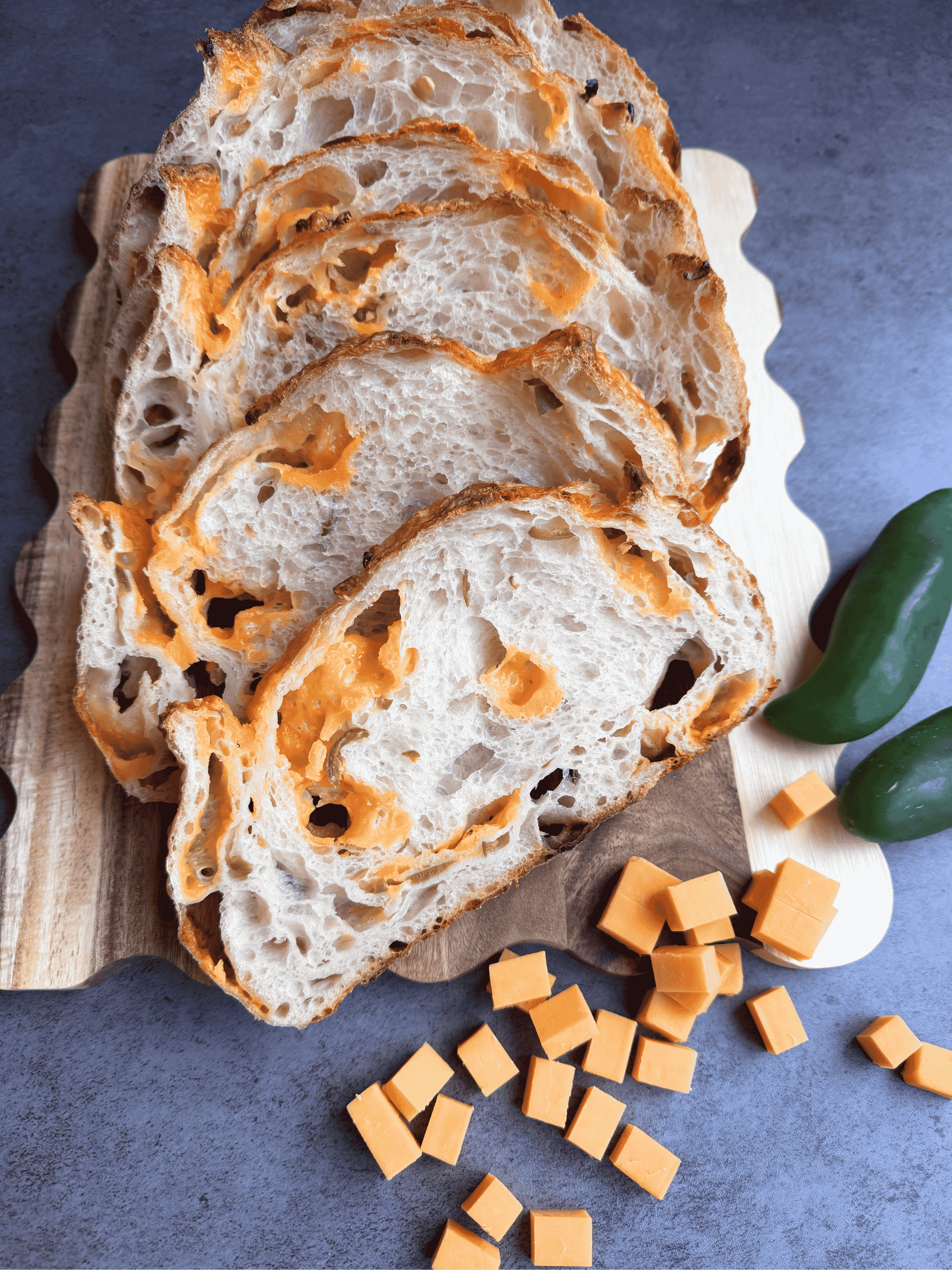
Ingredients
Method
- Step 1: Night before - Feed Starter
- Feed your starter and let it come to peak. It is always my recommendation to feed your starter the night before a higher ratio that will take all night to peak and is ready to go int he morning. In my kitchen where it is 70F overnight, I feed my starter a 1:3:3 ratio night before. I take 25g refrigerated starter, add 75g warm water, and 75g flour. Mix and let sit overnight. Next day you’ll have 175g of peaked starter. Use 125g for the loaf and there’s still 50g left over to put back in the fridge.
Step 2: Next morning - Mix the Dough
- In a glass measuring bowl, combine your water and active (at peak) starter and stir until the starter is mostly dissolved. Add your bread flour and salt, and mix by hand until no dry flour remains and you have a shaggy, cohesive dough. Cover and let it rest for 1 hour. Bulk Fermentation has started.While the dough is resting, cube your cheese and slice your jalapenos and set them aside.
Step 3: Stretch & Fold - round 1
- After 1 hour of dough resting, do your first set of stretch and folds — grab one side of the dough, stretch it up and over to the opposite side, rotate the bowl, and repeat on all four sides. Cover and let rest 30 minutes.
Step 4: Add your inclusions, Stretch & Fold - round 2
- Option 1: Scatter about a third of your cheese and jalapeños over the dough, stretch & fold, rotate, add another third, stretch & fold fold, rotate, and finish with the last third. Perform a couple more stretch and folds, cover and let rest 40 minutes this time. (Because we added cold ingredients to the dough, cold dough takes longer to relax, so we will give it a longer rest time before performing the next round of stretch and folds).
- Option 2: Laminate the inclusions: very lightly spray the counter with water, scrape your dough out of the bowl onto the counter. Spray some water on your hands and gently stretch the dough out as thin as it will go without tearing. Sprinkle the cheese and jalapenos all over the top, fold the dough like a letter first and then again from top to bottom until you have a square. Round it into a circle with your hands and place back in the bowl. Cover, let rest 40-45 minutes.
Step 5: Stretch & Folds - Round 3 and 4
- First, flatten the dough in the measuring bowl and make note of the level where the dough sits (for example 1000ml), this will help you determine where the dough needs be based on the dough percentage rise you are aiming for. If I am going for double in size, I'll wait until the dough rises to 2000ml before shaping.
- Do two more sets of stretch and folds at 40-minute intervals, then let it rest, covered and rise to your desired bulk percentage rise. Depending on your dough temperature, this may be anywhere from 75% rise all the way to 125% rise. If your dough temp is above 75F, you may want to aim at 75-80% rise, if the dough temp is way below 70F, you can push that bulk rise to 100% or up to 125%.
Step 6: Shape the Loaf
- Turn your dough out onto a lightly floured surface. Shape it into a tight round or oval boule. Place it seam-side up in a well-floured banneton or a bowl lined with a floured kitchen towel. Rest 15 minutes. Tighten the shape by pinching the seam together a little tighter if it came apart.
Step 7: Cold Ferment
- Cover and refrigerate your shaped loaf for 8–24 hours. This slow, cold fermentation is where a lot of the flavor complexity develops, and it also firms the dough up, which makes scoring much easier.
Step 8: Preheat oven and Score the loaf
- About 1 hour before you’re ready to bake, preheat your oven to 500°F with your baking vessel inside. A Dutch oven works beautifully here, but it is absolutely not a requirement — a baking steel or baking stone with a separate pan of water or ice cubes underneath for steam.Turn your cold dough out onto a large sheet of parchment paper and score the top with a sharp blade or lame.
Step 9: Bake
- Once the loaf goes in the oven, lower the temperature to 450F. If baking in a Dutch oven: bake covered for 20 minutes, then remove the lid and bake for another 20–25 minutes until deeply golden. If open baking on a steel or stone: bake with steam for the first 20 minutes, then remove the steam pan and continue baking for another 20–25 minutes.
- Cool for an hour or so before slicing.
Check internal temperature of the baked loaf with probe thermometer. You are looking for a minimum of 198F.