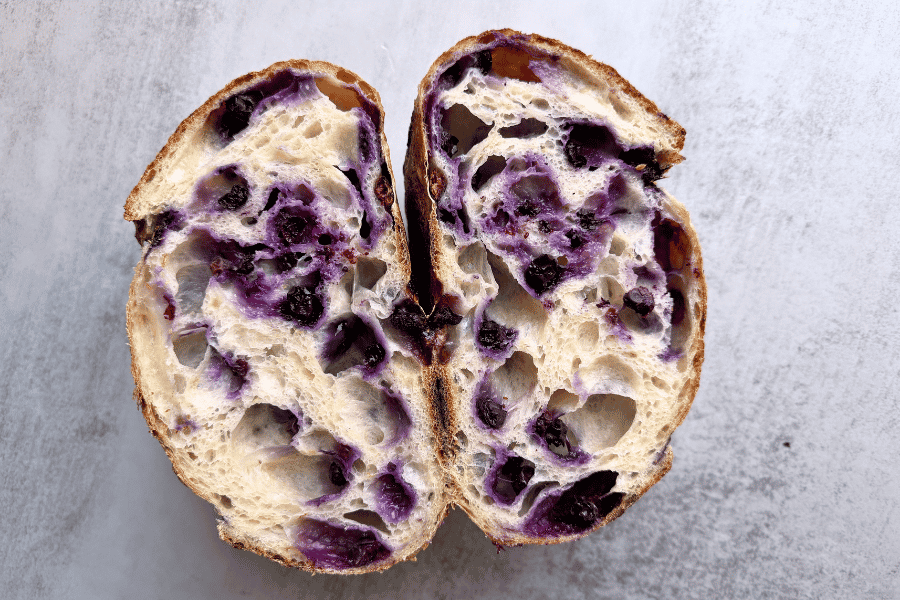
Ingredients
Method
1. Prep your starter:
- Feed your starter and let it reach peak activity — bubbly, doubled or more, with a dome on top that has leveled off and showing dimpling and beginning signs of receding. This timing will depend on kitchen temperature and starter feeding ratio. If your schedule doesn't line up with a same-day bake, feed it, let it peak, then refrigerate for up to 3 days and use it straight from the fridge — no need to feed again right before mixing.
2. Mix the dough:
- In a large bowl, whisk 300 grams lukewarm water (1 1/4 cups + 1 tbsp) and 100 grams active sourdough starter, at peak (about 1/2 cup) together until the starter is mostly dissolved. Add 400 grams bread flour (about 3 1/4 cups) and 8 grams salt (about 1 1/2 tsp), and mix well — knead right in the bowl for about 2 minutes until you have a shaggy but cohesive dough with no dry patches of flour. Dough will be sticky, that's normal. This short knead gives the gluten a head start, which matters more in an inclusion loaf. Cover and let rest for 1 hour.
3. First stretch & fold:
- Wet your hands slightly. Grab the dough from underneath, stretch it upward, and fold it over itself. Rotate the bowl and repeat on all sides until the dough resists a bit. Be careful not to allow the stretches to tear the dough. Cover and rest for 30 min.
4. Second stretch & fold — add blueberries and lemon zest: There are two good ways to add the fruit, both done during this same window:
- METHOD 1 — FOLD THEM IN: Sprinkle in 150 grams fresh blueberries (about 1 cup) — fresh only, not frozen or dehydrated gradually with each stretch and fold, along with the zest of 3 medium lemons, zested, folding gently. You're distributing fruit, not deflating structure or smashing berries.
- METHOD 2 — LAMINATE THEM IN: Gently stretch the dough out into a thin, even sheet, scatter the blueberries and lemon zest evenly across the surface, then roll or fold the dough back up to encase them.
- Both methods, done at this stage, give even fruit distribution. Avoid waiting until after bulk rise to laminate inclusions in — the dough has already built most of its structure by then, making it much harder to distribute fruit evenly.
- After adding the fruit, wet your hand and pat the dough level on top in your bowl to level it. Note where the dough sits in your measuring bowl (e.g. 900ml) — this is your baseline for tracking percentage rise later. Rest the dough 45 min.
5. Coil fold #1:
- Wet your hands and perform a gentle coil fold: tuck your hands under the dough in the center, lift the dough straight up, letting the ends fold gently underneath as gravity pulls them down. Rotate the bowl and repeat. This gentler technique strengthens the dough without disturbing the blueberries. Rest 45 minutes.
6. Coil fold #2:
- Repeat the coil fold a second time. Cover and set aside.
7. Bulk rise — by percentage, not the clock:
- Track the dough's rise by percentage against your baseline mark — not by the clock. In a 73°F kitchen, I let the dough double in size (100% rise): if it measured 900ml after adding inclusions, I watch for 1800ml. Above 77°F, aim for a 75% rise instead (900ml x 175% = 1575ml) to avoid over or underproofing. Warmer kitchens and humidity contribute to noticeably faster bulk rise, so check the dough itself, not just elapsed time.
8. Pre-shape and bench rest:
- Turn the dough out onto a lightly floured surface. Gently pre-shape into a round or oval and let it rest uncovered 15 min.
9. Final shape:
- Do your final shape — cup and drag the dough toward you to build surface tension, then tuck the seam underneath. Place seam-side up into a floured banneton.
10. Cold ferment (8-24 hours):
- Cover and refrigerate the shaped dough. This deepens the loaf's flavor and lets the sourdough tang play beautifully against the sweet-tart fruit. Anywhere within this window works, so build it around your own schedule.Note: The temperature in the refrigerator must be at 38F or lower in order to stop the dough from rising. If you notice a significant rise (more than a half inch) several hours in, bake it earlier then later.
11. Preheat and prep:
- Preheat your oven with your Dutch oven inside, if using. Tear off a large piece of parchment — larger than usual, since this loaf can release blueberry juice as it bakes and you want the parchment to catch it, not your Dutch oven.
12. Turn out and score:
- Flip the loaf out of the banneton upside down onto the parchment and score the top.
13. Bake:
- DUTCH OVEN: Lower the loaf (parchment and all) into the preheated Dutch oven. Bake covered at 450°F for 20 minutes, then remove the lid and bake 15-20 minutes more until deep golden brown. Note: To avoid the bottom of the loaf burning, after the 20 min bake with lid on, remove the loaf from dutch oven and place a round trivet in the dutch, or a couple of cups of rice, or a rolled up coil of aluminum paper. Place the loaf back in and bake uncovered the remainder of the time.Another option is to place a cookie sheet on a rack below the dutch oven during the entire bake to block some heat.
- OPEN BAKING: No Dutch oven needed — this loaf bakes beautifully open on a baking steel or stone with a steam pan below. Bake according to your usual open-baking method and temperature.
- Either way, check internal temperature before removing from the oven — you're looking for 200°F.
14. Cool:
- Let the loaf cool completely on a wire rack before slicing — this allows the crumb to finish setting.
Notes
FRESH BLUEBERRIES ONLY: Frozen berries — even thawed and patted dry — release too much moisture and lead to a wet, hard-to-shape dough with color bleeding. Dehydrated berries hold their shape but the flavor isn't the same. Fresh is worth waiting for if out of season.
STARTER FLEXIBILITY: Your starter doesn't need to be fed same-day. Feed it, let it peak, then refrigerate up to 3 days and use straight from the fridge.