Ingredients
Method
Night Before
- Step 1: Build your levain. In a small jar or bowl, combine the water, starter, rye flour, and bread flour. Mix well until no dry flour remains, cover loosely, and set it on your counter overnight.
- Step 2: Steep the caraway seed tea (if using). Pour boiling water over the caraway seeds, stir, cover loosely, and let it steep overnight alongside your levain.
The Next Morning
- Step 3: Mix the wet ingredients. In the bowl of a stand mixer, strain the caraway seed tea to measure out 335g (top off with plain water if you're short). If skipping the tea, just use 335g room-temp water. Add all of your levain (it should look flattened on the top and bubbly, dimples throughout, with a slightly sour, yeasty smell — that's how you know it's at peak), the molasses, oil, and 1 Tbsp of fresh toasted caraway seeds. (I discard the caraway seeds that were used for the tea as they no longer have much flavor left and add a fresh, lightly toasted tablespoon of seeds in the dough). Whisk to combine.
- Step 4: Add the flour and salt. Add the rye flour, bread flour, and salt. Mix on low speed with the dough hook for 2–4 minutes, until the dough comes together and looks well hydrated.
- Step 5: Knead. If kneading by hand, turn the dough onto an unfloured surface and knead until smooth, elastic, and tacky but not sticky, about 5–6 minutes. If using a mixer, this is where you'll split the process — see Step 6.
Splitting and Developing the Two Doughs
- Step 6: Divide the dough. Divide the dough in half. Leave one half in the stand mixer and set the other aside on a plate or your counter.
- Step 7: Knead the light half. Increase your mixer speed to medium (or as close as your machine tolerates with a stiff dough) and knead the dough in the mixer until smooth, elastic, and tacky but not sticky, about 5 minutes. Place it in a lightly oiled 4-cup measuring cup or bowl, pat it level, and note where the dough sits on the measuring line — this matters for the next step. Cover and set aside.
- Step 8: Make the cocoa paste and mix the dark half. In a small dish, stir the black cocoa powder and water together into a smooth paste. Add the second dough half back to your stand mixer along with the cocoa paste, and mix on medium-low until the color is even and the gluten has developed, about 5 minutes. Place in a separate lightly oiled bowl and cover.
- Step 9: Bulk rise by percentage, not by the clock. Let both doughs rise until they've increased by about 50% in volume. For example: if your light dough started at the 450ml mark in your measuring cup, you're looking for it to reach roughly 675ml.
Shaping the Marble Swirl
- Step 10: Stretch both doughs. Once both doughs have risen, turn them out onto a lightly floured surface. Stretch each piece into a rough rectangle, about 5 by 10 inches.
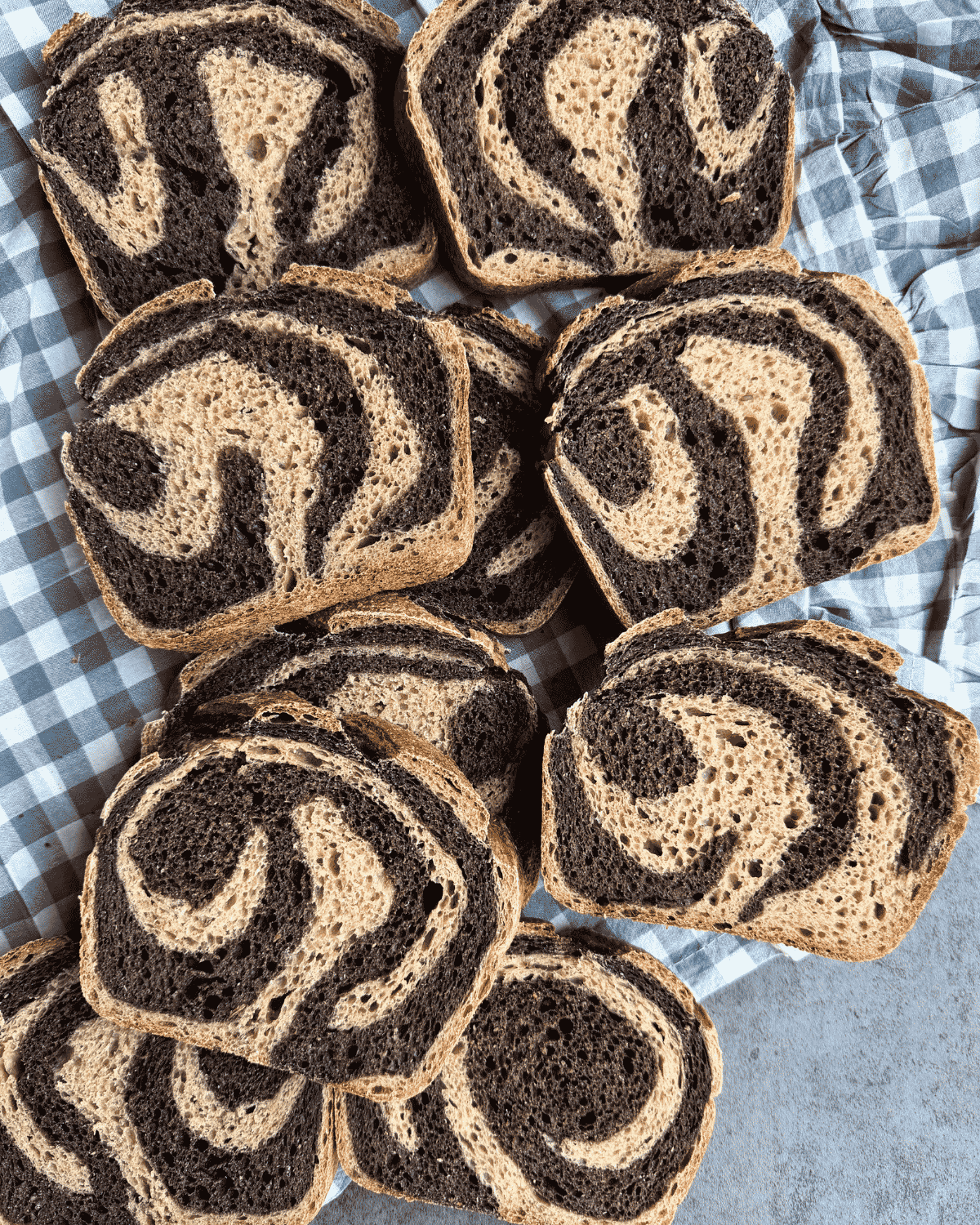
- Step 11: Layer the two doughs. Place the dark rye rectangle on top of the light rye rectangle, offset about halfway up, so the light dough peeks out at the bottom and the dark dough peeks out at the top, with the middles overlapping. If the dough feels sticky as you work, lightly oil your fingertips rather than reaching for more flour — extra flour at this stage can create dry seams in your finished swirl.
- Step 12: Fold and turn. Fold the bottom (light) portion up and over the dark layer, then fold the top (dark) portion down over that. You'll now have a square that reads, from bottom to top: light, dark, light, dark. Turn the square 90 degrees and gently pat it into a rectangle roughly 5 inches wide and 8 inches long.
- Step 13: Roll and place in the pan. Roll the dough up tightly but gently from the bottom, like a jelly roll. Place the log seam-side down into a lined and lightly greased 9x4-inch loaf pan.
Final Rise and Baking
- Step 14: Second rise. Mist the top of the loaf lightly with cooking spray and cover with plastic wrap or a shower cap. Let it rise until doubled.
- For a deeper flavor, place the shaped loaf in the fridge overnight for a cold ferment. Pull it out the next day and let it finish rising at room temperature until doubled before baking — an easy way to work sourdough into a real, busy schedule.
- Step 15: Score and bake. Preheat your oven to 375°F. Score the top of the loaf with a single slash down the center, or several angled slashes, about ¼ inch deep. Bake on the center rack for 40–45 minutes, rotating the loaf 180 degrees halfway through, until golden brown and baked through. An internal temperature of 200°F is your best indicator of doneness.
- Step 16: Cool. Let the loaf rest in the pan for 5 minutes, then remove it from the pan and lining and transfer to a cooling rack. Brush the top and sides with melted butter for a glossy, soft crust. Let the loaf cool completely before slicing — I know it's tempting, but cutting into hot rye bread leads to a gummy crumb, and this loaf deserves better than that.