Ingredients
Method
INSTRUCTIONS
Night Before
- Make the yudane. Pour 80g of boiling water over 80g of flour in a small bowl and stir vigorously until smooth and no dry flour remains. Cover and refrigerate overnight.
- Build the sweet stiff starter. Combine 35g of active starter, 100g of flour, 45g of warm water, and 15g of sugar. Mix and knead until you have a stiff, smooth dough ball. Cover loosely and leave at room temperature overnight, until roughly tripled in size with a domed top and a sweet, fruity smell.
Baking Day
- Mix the dough. Combine the cold Half & Half, yudane, sweet stiff starter, sugar, salt, egg, and flour in a stand mixer fitted with the paddle attachment. Mix on low for 1–2 minutes until no dry flour remains.
- Knead. Switch to the dough hook and knead on low-medium speed for 5–8 minutes, until the dough is smooth and elastic. Add the softened butter in 2–3 additions, fully incorporating each before adding the next. Continue kneading for 6–8 more minutes until the dough is smooth, glossy, and passes the windowpane test.
- Bulk rise. Transfer to a lightly greased bowl and cover. Ferment at room temperature until the dough increases by 75–80% in volume — about 3–5 hours depending on your kitchen's temperature. Watch the rise, not the clock.
- Divide and shape. Turn the dough onto a lightly floured surface and divide into 6 equal pieces (roughly 138g each) for large buns or 8 pieces for medium size buns. Shape each into a tight, smooth ball and place on a parchment-lined half sheet pan, spaced a few inches apart.
- Final proof. Cover loosely and proof at room temperature for 2–4 hours, until the buns look noticeably puffy, feel soft and pillowy to the touch, and spring back slowly when gently pressed.
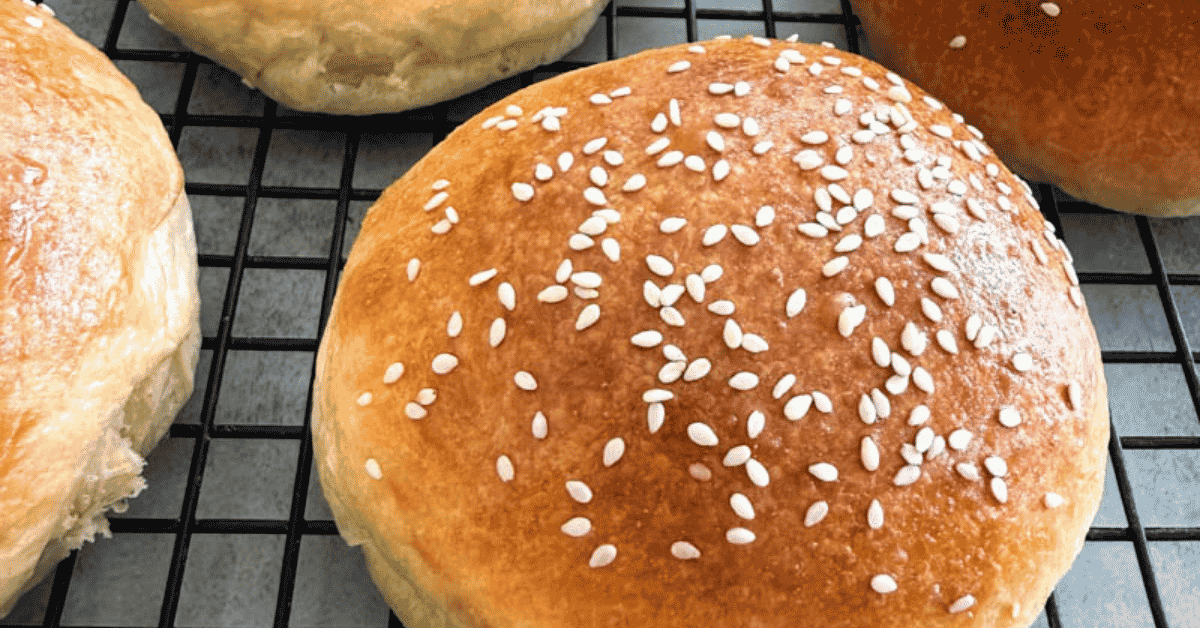
- Top and bake. Preheat oven to 375°F (190°C). Gently brush each bun with egg wash and sprinkle with sesame seeds. Bake for 18–22 minutes, until deeply golden brown and the internal temperature reaches 190°F (88°C).
- Cool. Transfer to a wire rack and cool completely, at least 30–40 minutes, before slicing.
Notes
NOTES
The sweet stiff starter should be used right at peak — tripled and domed, before it begins to deflate. Using it past peak will result in a more sour bun.
Cold Half & Half is intentional. It helps offset the friction heat generated by the stand mixer, keeping the dough from warming too fast during kneading.
The dough will feel soft and slightly tacky even when fully developed. Resist adding extra flour.
Room temperature: Store in an airtight bag or container for up to 3 days. Thanks to the yudane, these stay noticeably soft longer than a standard sourdough bun.
Freezer: Cool completely, wrap individually, and freeze for up to 3 months. Thaw at room temperature or microwave in short bursts wrapped in a damp paper towel.
For hot dog buns, shape each piece into a log and bake with sides touching for a pull-apart result.
The sweet stiff starter should be used right at peak — tripled and domed, before it begins to deflate. Using it past peak will result in a more sour bun.
Cold Half & Half is intentional. It helps offset the friction heat generated by the stand mixer, keeping the dough from warming too fast during kneading.
The dough will feel soft and slightly tacky even when fully developed. Resist adding extra flour.
Room temperature: Store in an airtight bag or container for up to 3 days. Thanks to the yudane, these stay noticeably soft longer than a standard sourdough bun.
Freezer: Cool completely, wrap individually, and freeze for up to 3 months. Thaw at room temperature or microwave in short bursts wrapped in a damp paper towel.
For hot dog buns, shape each piece into a log and bake with sides touching for a pull-apart result.