Ingredients
Method
Step 1: Mix the Dough
- In a large bowl, combine the lukewarm water and active sourdough starter. Whisk until the starter is mostly dissolved and the mixture looks cloudy. Add the bread flour and sprinkle the salt on top. Mix until no dry flour remains — mixing by hand is best. The dough will look shaggy and sticky, and a little rough. But give it a good 3 minutes of thorough kneading.
- Flatten the dough slightly in your bowl, note the starting volume (if you’re using a clear measuring bowl, mark the level — this will be your reference point for tracking the rise), and cover with a damp towel, plastic wrap, or a shower cap.
- Pro Tip: A clear glass measuring bowl is one of the most useful tools in sourdough baking. Once you mix your dough and mark the starting level measurement, you can calculate exactly how far it needs to rise without relying on the clock. For this recipe, we’re watching dough percentage rise, not timing.
Step 2: Rest (1 Hour)
- Let the dough rest, covered, for 1 hour. This fermentolyse rest lets the flour hydrate fully and begins gluten development naturally. By the end of this hour the dough will look slightly smoother and feel noticeably less rough.
Step 3: First Stretch & Fold
- After the rest, perform your first set of stretch and folds. With wet hands, reach under one edge of the dough, stretch it up as high as it will comfortably go without tearing, and fold it over the top to the opposite side. Rotate the bowl a quarter turn and repeat, working your way around until the dough starts resisting and gathers into a rough ball — usually 4–6 folds. Cover and rest for 40 minutes.
- Pro Tip: Don’t stress if your stretch and fold timing is off by 10–15 minutes. Sourdough baking is forgiving. Miss a set entirely? The loaf will still be excellent. Perfection is not the goal — consistency and attention are.
Step 4: Lamination — Where the Magic Happens
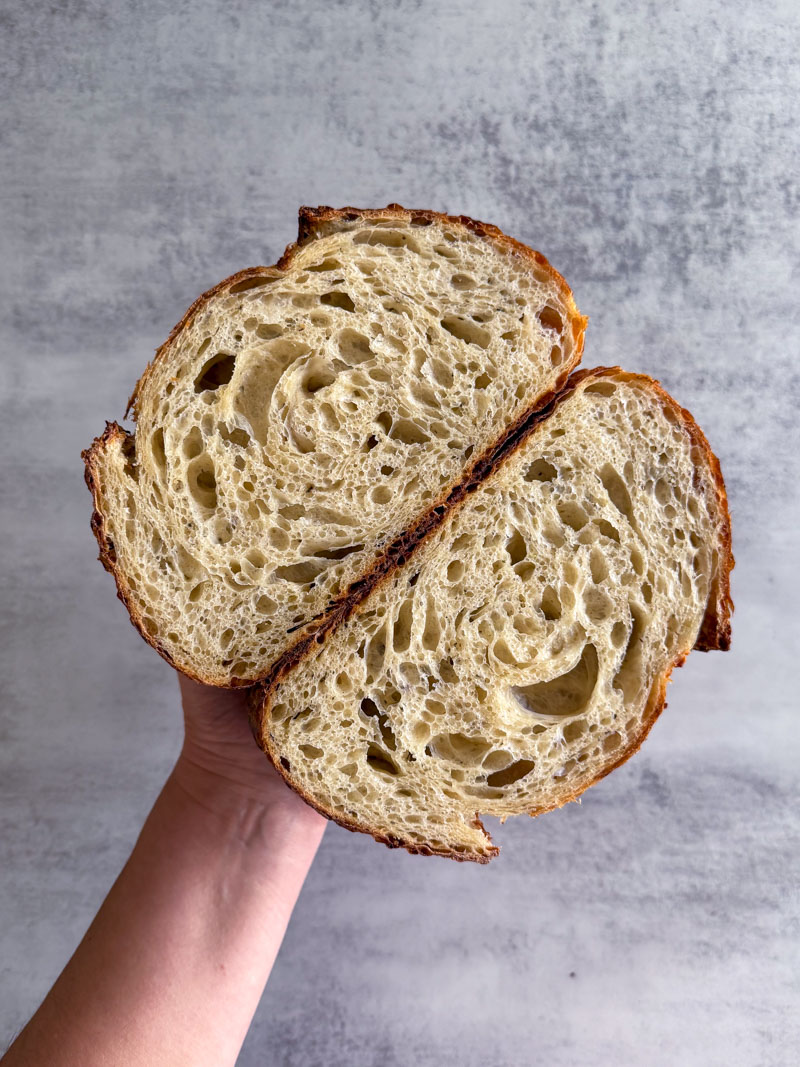
- This is the step that sets an inclusion loaf apart, and it’s more approachable than it sounds. Lamination is simply the act of stretching the dough out thin across your work surface, adding the inclusions directly onto that surface, and then folding everything back into a neat package. It’s the most effective way to distribute flavors evenly through every layer of the crumb.
- Alternative to lamination: You can sprinkle the inclusions right on top of the dough in your bowl. Press it in with your fingers, dimpling the inclusions in and proceed with your stretch and folds.
- If laminating, lightly mist your clean counter with water (this prevents sticking without adding extra flour and disrupting hydration). Turn the dough out and use your fingertips to gently stretch it outward in all directions — slipping your fingers underneath and easing it out in every direction — until it’s fairly thin. Stop before it tears in a way that can’t be recovered.
- Sprinkle the Italian seasoning evenly across the surface. Follow with the dehydrated minced garlic, distributing it as evenly as you can — thin, even coverage will mean every slice is flavored. Finally, scatter the freshly grated parmesan across the whole surface.
- Now fold: bring the left third to the middle, then fold the right third over it (like a business letter). Fold the top third down and the bottom third up. You should have a neat rectangular package. Tuck it into a ball shape and place it back into your bowl, seam side down.
Step 5: Coil Folds & Bulk Fermentation
- Cover the bowl and rest for 40 minutes. Then perform a set of coil folds: with wet hands, slip both hands under the center of the dough, lift it up so the sides fall and coil underneath, then set it back down. Rotate the bowl 180° and repeat. Cover and rest another 40 minutes, then do one more set of coil folds.
- Now the dough rests, covered, until it reaches the right volume rise. This is where I want you to watch the dough — not the clock.
- The percentage rise method: Rather than setting a timer and hoping for the best, use your starting volume mark to track progress. The target rise percentage depends on your kitchen and dough temperature among other things I always recommend starting with “double in size” and adjust on your next loaf up or down:
- Below 74°F: Allow the dough to double in size (100% rise, if the temperature is cooler than 71F, I would push the rise further than double in size)
- 74°F–78°F: Aim for a 80% rise
- Above 78°F: Watch for a 70% rise and shape sooner to avoid over-fermentation
- This is one of the most important things I teach in my sourdough classes: bulk fermentation is done when the dough tells you, not when the timer goes off. Temperature, humidity, and your starter’s strength all affect timing. The volume method removes the guesswork.
Step 6: Pre-Shape & Bench Rest
- Turn the dough out onto a lightly floured surface. Using a bench scraper or your hands, gather the edges under and toward the center, working your way around until the dough forms a rough ball with some surface tension. Flip it seam-side down and let it rest, uncovered, for 15–20 minutes. This bench rest lets the gluten relax after all that development, making final shaping much more cooperative.
Step 7: Final Shape
- For a round (boule): Cup your hands around the dough and drag it toward you on the counter in circular motions, tucking the dough under with your pinky fingers. The surface should become smooth and taut with each pass.
- For an oval (batard): Gently stretch the dough into a rough rectangle. Fold in by thirds like a letter, then roll up. Drag and tighten using the same motion as above.
- Place the shaped loaf, seam side up, into a well-floured proofing basket (banneton) or a bowl lined with a floured kitchen towel.
Step 8: Cold Proof
- Cover the basket tightly with a shower cap or plastic wrap and refrigerate for 8–24 hours. This cold fermentation step does two essential things: it develops the complex flavor you want from a properly fermented sourdough loaf, and it firms the dough up significantly, making it much easier to score cleanly. The parmesan will partially firm up during this time as well, which helps it hold its position in the crumb rather than sliding.
- The cold proof window is flexible — 8 hours is a minimum, 16 is comfortable, and I’ve baked loaves that sat for up to 2 days with excellent results. This is one of the most forgiving steps in the entire process. Fit it around your schedule, not the other way around.
Step 9: Score & Bake
- Preheat your oven to 500°F (260°C) for 30–60 minutes with your Dutch oven (with lid) or baking steel on middle rack and metal empty pan on lower rack inside.
- Remove the loaf from the refrigerator and turn it out onto a piece of parchment paper, seam side down. Dust lightly with flour. Score immediately with a sharp lame or razor blade — a single confident slash at a slight angle, about ¼” deep, works beautifully. You can also do a simple cross or add decorative scoring if you’re feeling ambitious. The cold dough is firm and forgiving for scoring; don’t hesitate.
- Dutch Oven Method: Take the Dutch oven out of the oven, remove the lid, and carefully lower the parchment with the dough into the pot. Replace the lid and bake at 450°F (232°C) for 20 minutes covered, then remove the lid and bake an additional 15–20 minutes until the crust is a deep golden brown and the internal temperature reads at least 198°F (92°C).
- Open Baking Method: No Dutch oven? Not a problem — this is a completely valid and reliable approach. Slide the scored dough onto your preheated baking steel or cookie sheet. Add steam immediately by pouring 2 cups of boiling water or dropping ice cubes into the empty metal pan on the lower rack, then close the oven quickly. Bake at 450°F (232°C) for 35–40 minutes, rotating once halfway through.
- Watch Out: Parmesan on the surface of the loaf can brown faster than a plain crust. Keep an eye on your loaf from about the 25-minute mark and tent loosely with foil if the cheese is browning faster than the bread is baking through. The goal is deep golden, not burned.
Step 10: Cool Before Slicing
- Remove the loaf from the oven and let it cool on a wire rack for a minimum of 1 hour before slicing. I know. The smell at this point is almost unbearable. But slicing too early releases the steam trapped inside the crumb, resulting in a gummy, dense interior that doesn’t do justice to all the work you just put in. Give it the hour. It’s worth it.